
 Messaging CPaaS
 Database cleansing and verification (MNP/HLR)
 Messaging communication
 Communication platform
 Accurate routing (MNP/HLR)
 Messaging hub
 2FA
 Marketing and promotions
 Banking
 Retail
 Government
 Increase of ROI
 CX improvement
 CRM integrations
 Loyalty increase
Can I Send Bulk SMS Through an API?
Bulk SMS API integration makes high-volume messaging faster, simpler, and more scalable.
Businesses use a bulk SMS API to automate large-scale messaging, connect SMS to CRM systems
and applications, and reach customers across international markets.
However, submitting thousands of messages is only one part of the process. Delivery performance
depends on API throughput, routing quality, operator connectivity, and traffic monitoring.
Understanding these factors helps businesses select the right infrastructure for reliable A2P SMS communication.
What Is a Bulk SMS API and How Does It Work?
A bulk SMS API connects business software to an SMS platform, allowing messages to be submitted automatically without manual campaign management.
Bulk SMS API integration is commonly used for:
- OTP and authentication: verification codes and security alerts.
- Transactional SMS: order confirmations, payment updates, and delivery notifications.
- Marketing campaigns: promotions, loyalty programs, and customer engagement.
- Service notifications: appointment reminders and operational alerts.
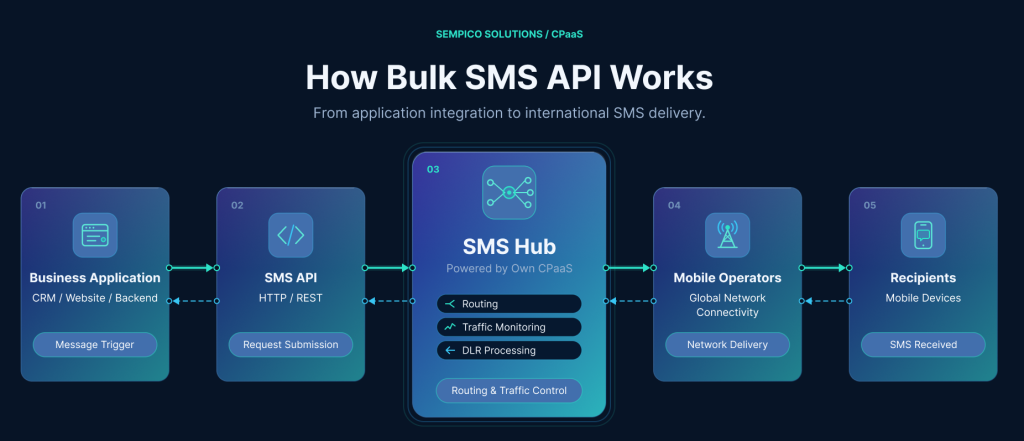
The process typically follows five steps:
- Integration: Connect your application through an HTTP or REST API using authentication credentials.
- Preparation: Validate recipient numbers, check messaging permissions, and prepare message content.
- Submission: Send individual or batch API requests, depending on the platform.
- Routing: The SMS infrastructure processes traffic and forwards messages toward destination networks.
- Monitoring: Track delivery outcomes through delivery reports (DLRs) and traffic logs.
For example, a retailer can submit 100,000 order notifications through an API. Even if every request is accepted, delivery may vary between networks. API acceptance confirms processing, not final delivery.
What Matters When Sending Bulk SMS at Scale?
A reliable bulk SMS messaging API should support more than message submission.
Throughput and Traffic Management
Throughput determines how many messages can be processed per second. API rate limits, message queues,
and operator capacity influence performance during traffic peaks.
Businesses should evaluate both expected volumes and maximum submission rates before launching large campaigns.
International SMS Routing
Different destinations have different network conditions and messaging requirements.
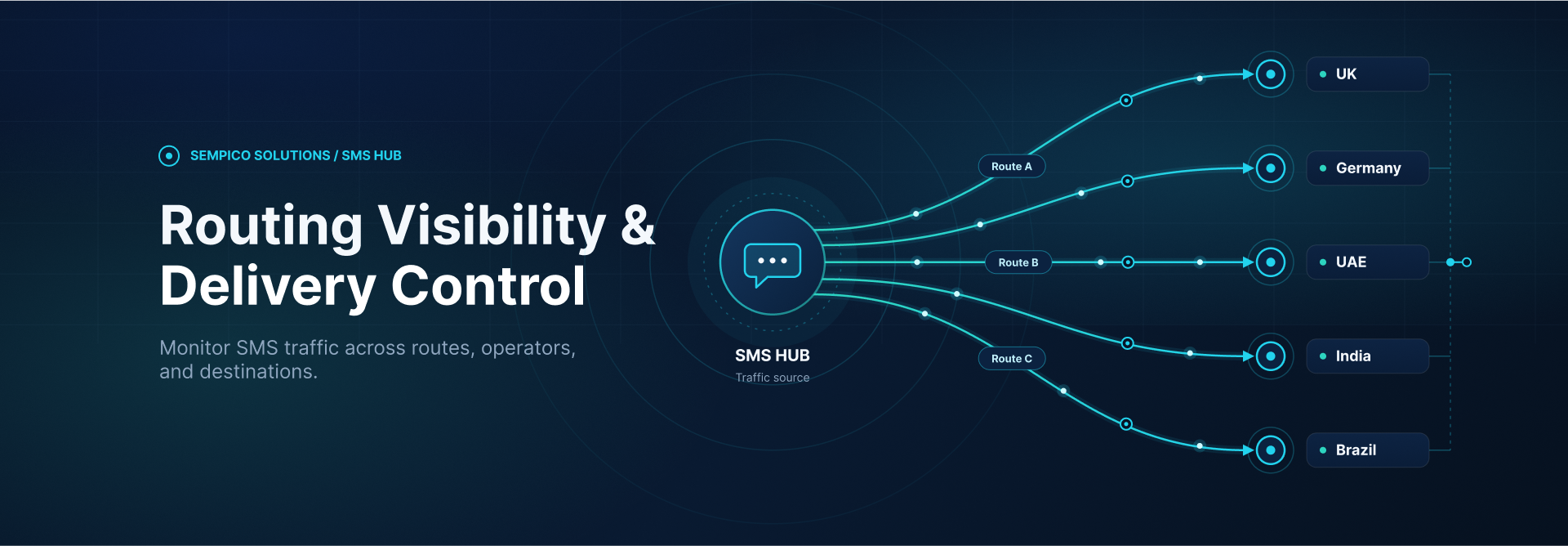
A bulk SMS gateway API connects applications to messaging infrastructure, while routing systems determine how traffic is forwarded through telecom connections.
Monitoring route performance helps identify delivery delays and manage international SMS operations.
Delivery Reports and Number Intelligence
DLRs provide visibility into delivered, failed, and expired messages where supported by the network.
HLR and MNP lookup services can provide additional number intelligence, helping businesses assess recipient data and identify relevant operator information.
Together, these capabilities improve operational visibility and support more informed routing decisions.
How Much Does a Bulk SMS API Cost?
Bulk SMS API pricing depends on destination countries, mobile operators, messaging volumes, and commercial routing conditions.
Businesses should consider three factors:
- Destination rates: SMS costs differ across countries and networks.
- Message segmentation: Longer messages or certain character encodings may require multiple billable SMS segments.
- Delivery performance: A lower message rate does not always mean a lower effective cost per delivered SMS.
When comparing bulk SMS API providers, evaluate pricing alongside delivery reporting, routing transparency, and technical support.
SMS API vs. SMS Gateway: What’s the Difference?
An SMS API is the interface that allows software to submit messages automatically.
An SMS gateway processes and forwards messaging traffic toward mobile networks.
HTTP and REST APIs are commonly used for enterprise applications, while SMPP is often used by telecom aggregators and wholesale messaging businesses.
The right integration method depends on traffic volume, technical architecture, and operational requirements.
Why Choose Sempico Solutions for Bulk SMS API Integration?
Sempico Solutions operates as an international SMS Hub powered by its own CPaaS platform, connecting enterprises and messaging partners with telecom operators and suppliers.
Our infrastructure combines:
- Global A2P SMS connectivity for enterprise and wholesale traffic.
- API and SMPP integration for automated messaging.
- Routing control for international SMS traffic management.
- DLR and traffic monitoring for delivery visibility.
- HLR/MNP lookup for number intelligence.
For enterprises, this means integrating SMS into existing business applications while maintaining visibility into delivery performance.
For telecom and CPaaS partners, it means managing messaging traffic through infrastructure designed for routing control and operational transparency.
The value goes beyond sending messages: businesses gain greater insight into what happens after traffic enters the SMS network.
Frequently Asked Questions
Can I send bulk SMS through an API internationally?
Yes. International bulk SMS is possible through platforms with global telecom connectivity. Sender ID restrictions and messaging regulations vary by country.
How many messages can a bulk SMS API send per second?
Throughput depends on API limits, platform capacity, and destination networks. High-volume campaigns require appropriate capacity planning.
Can I connect a bulk SMS API to my CRM?
Yes. SMS API integration allows CRM systems and business applications to trigger automated notifications, authentication messages, and marketing communications.
Does an accepted API request guarantee SMS delivery?
No. API acceptance and final delivery are separate events. Delivery reports help businesses monitor the available delivery status.
Ready to Scale Your SMS Traffic?
Planning bulk SMS API integration across multiple countries?
Sempico Solutions helps businesses connect to global A2P SMS networks with routing control, delivery visibility, and flexible integration options.